Food insecurity
According to the United States Department of Agriculture (USDA), food insecurity is a household-level economic and social condition of limited or uncertain access to adequate food (Rabbitt, Hales, & Reed-Jones, 2025). Food insecurity is a spectrum, and people may experience it intermittently, depending on their financial situation. Experiencing economic hardships not only affects people in the present but can also have long-lasting effects. Many health conditions are influenced by one’s ability to access nutritionally dense foods and studies show food insecurity is associated with increased risk of developing heart disease (Jia & Carnethon et al., 2025). Furthermore, the availability of resources and benefits is not always widely known, or people may lack the resources or time to take advantage of the benefits available.
Lenawee County and the State of Michigan’s overall food insecurity rates have followed a similar trend from 2019 to 2023. The percentage of people who experience food insecurity in Lenawee County has increased by 2.8% since 2019 (Feeding America, 2019-2023). The largest decrease (10.8%) occurred in 2021, but the rate quickly increased by 3% in 2022 and continued to climb in 2023 (Figure 11). Aside from a slightly higher rate in Lenawee County in 2020 and 2021, food insecurity rates are climbing, though still slightly below the state’s rate.
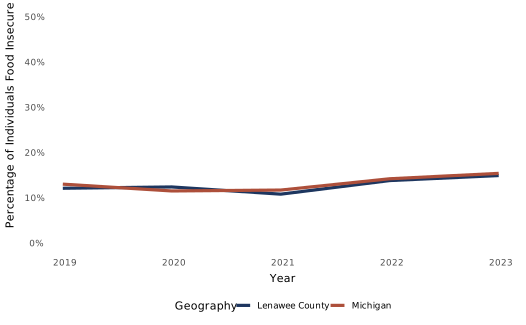
Figure 11. Food insecurity rate, Lenawee County and Michigan, 2019–2023
Resources
- Feeding America. (2019–2023). Map the Meal Gap. Feeding America. https://www.feedingamerica.org/research/map-the-meal-gap
- Jia, J., Carnethon, M. R., Wong, M., Lewis, C. E., Schreiner, P. J., & Kandula, N. R. (2025). Food insecurity and incident cardiovascular disease among Black and White U.S. individuals, 2000–2020. JAMA Cardiology, 10(5), 456–462. https://doi.org/10.1001/jamacardio.2025.0109
- Rabbitt, M. P., Hales, L. J., & Reed-Jones, M. (2025, October 1). Food security in the U.S. – Definitions of food security. U.S. Department of Agriculture, Economic Research Service. https://www.ers.usda.gov/topics/food-nutrition-assistance/food-security-in-the-us/definitions-of-food-security
- Explore additional data points and resources